


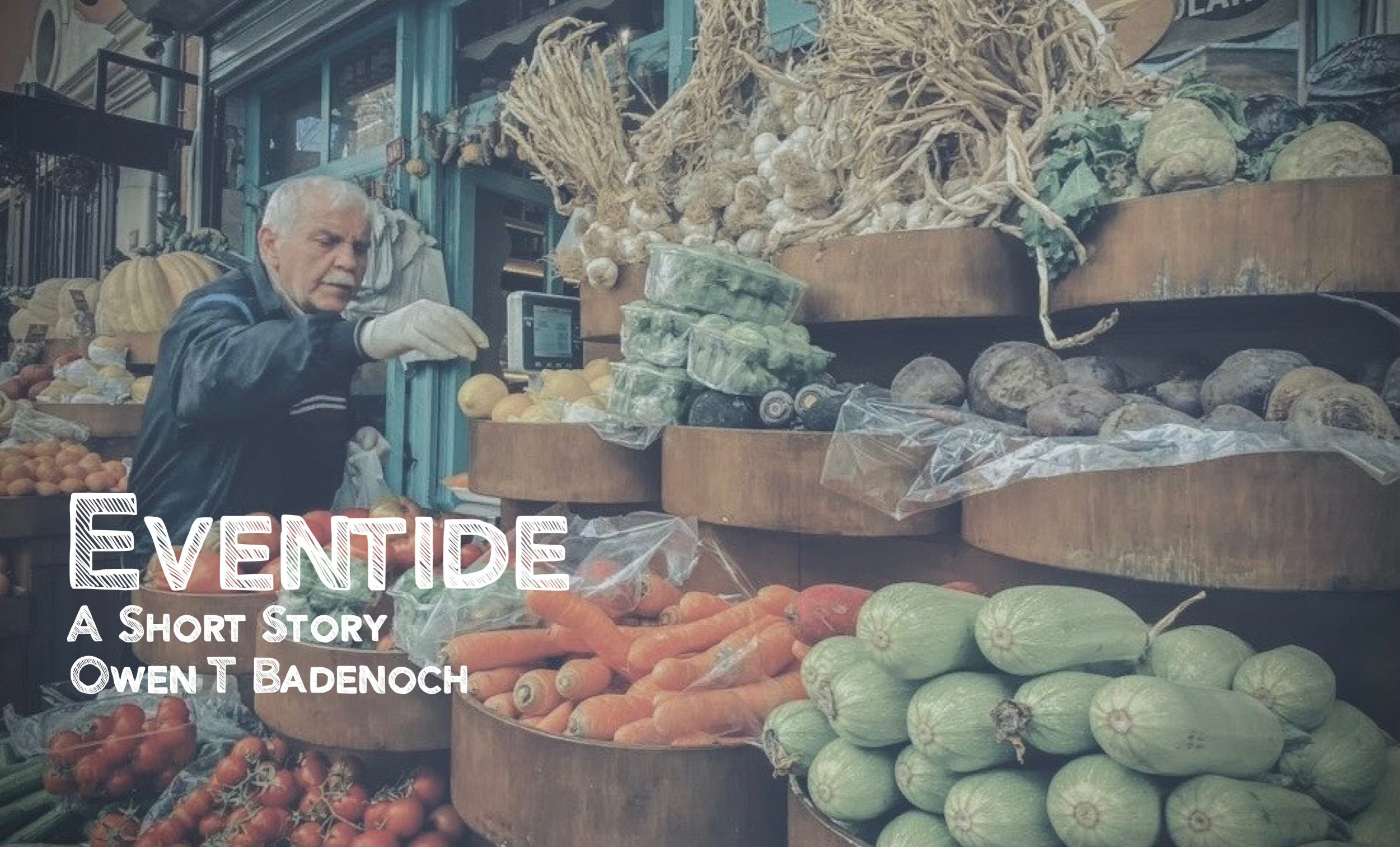
Something a little different this week: NOT sci-fi! Just regular fi! The fourth week of each month I plan to share a work of short fiction (in varying genres/styles) or possibly an article. I hope you enjoy it.
Please let me know what you think in the comments or by message. Happy reading!
-Owen.
“Eventide”
by Owen Badenoch, (6800 words)
Stan Bronaugh brings the old boat of a car around the back of his grocery shop. He eases it into the wide alley off of Yonge street where he always parks, and pulls it alongside the brick wall on his left until the front bumper is almost aligned with the back door. This has the effect of forcing him to slide across and exit via the passenger side door. It’s one of the reasons he hasn’t yet traded in his 1990 Buick LeSabre. Old habits, he thinks as the door groans open and he eases out into the cool air of an early autumn morning.
When his lovely Alina, God rest her soul, had used to come with him in the mornings, he would have to wait while she got her purse together, and her glasses, and whatever else, and then got out, before he could slide across the bench and get out. He’d wait silently, cramped in the front seat wearing his puffy winter parka, like an astronaut stuffed into a space capsule. How that woman managed to unpack half her purse onto her lap in the fifteen minutes it took to get from their house to the shop, he never understood. But he could hardly complain. He wasn’t getting out to open her door for her, like he ought to be doing, he knew. It was one of the small compromises that had formed the silent latticework structure of their thirty-nine year marriage. Now, when he slides across the seat, it feels too wide and empty, a great distance to reach across to open the far door. Maybe it’s getting time to change the car, after all. In a few more years it’ll be a new millennium. What a thought!
He takes a moment to stretch as he stands fully upright, an action he does slowly, feeling his lower back complain, but not too loudly today. He feels as old as the car looks. One long stripe of blue, cloudless sky stretches above him between the buildings of the back alley. His shop’s green dumpster is on the other side of the shop’s back door and one of its flaps is up. Now, who would’ve done that? He always makes sure they’re closed and fastened before he goes home each night. Otherwise the raccoons get in and make a mess. He’s careful not to slam the car door, but it always needs a firm push to actually get all the way closed, and grunts as he saunters over to the dumpster. Stan kicks the side of the dumpster and steps back, bracing in case some creature jumps or flies out, but no creature does. So he reaches up and closes the flap, careful not to let it slam, much like the car door. Stan has never much felt the necessity to make loud, shocking noises. He hardly ever even shouts or raises his voice. He supposes himself to be a quiet man, overall, though he doesn’t know if that really means anything. He just doesn’t have much call to be loud, is all.
The shop’s back door lock is sticky and he wiggles the key until it finally surrenders and opens. It will be worse in winter. Maybe he should call the locksmith to come and look at it. One more thing on a never-ending to do list. But that’s alright. Gerry, the locksmith, is an old friend and he hasn’t been in touch in too long anyway. Stan is smiling as he opens the back door, but winces at the squeal of the hinges. Okay, add that to the list as well. Everything is getting old and worn out, it seems.
Inside the shop, the harsh red digital clock readout stares out at him from the murky dark interior. 6:48AM. He flips the six light switches and the small grocery shop flickers into being in front of him. Four rows divided by two aisles. Fresh greens and veggies down the left, packaged food and dry goods down the right. The back wall is mostly coolers with drinks and a few dairy goods. He doesn’t like carrying dairy. It isn’t a convenience store or a supermarket, after all. But somehow he has never bothered to stop the regular order. Deliveries, twice weekly, from Becker’s, and it usually sells fine, so he lets it stay. Is that delivery today? What day is it today? He shakes his head.
“I really am getting old, aren’t I, George?” he says aloud with a rueful chuckle and he looks at the cat’s cushioned box in the corner just inside the door. Except it’s not there. That’s right, he thinks. Cat’s gone, too. But that was two winters ago. The fat grey feline had a good long life. A simple, happy life, lounging in the late afternoon sun. Never caught a single mouse, though. Would just stare at the birds on the sidewalk. George was Alina’s cat, not Stan’s. George made that clear with his little tail flicks and purrs for Alina, and his utter indifference to Stan’s presence, an indifference which Stan, for his part, had reciprocated just fine.
Feeling old is nothing new to Stan. He has felt like an old man for as long as he remembers. Like he was part of that older, different generation. He was a child, and then he was a grown man. There wasn’t any real in-between. Gerry, one of his oldest friends in the city, and who insists on bestowing everyone he meets with some kind of nickname or other, has even called him ‘Old Man Stan’ since they were in their late twenties. It was something about the thick sweaters that Stan always wore. Being old, on the other hand, feels like maybe his body has finally caught up with him.
There is a kind of satisfaction with this way of getting old, though, Stan thinks. A steadiness, a consistency. Even a kind of pride in it. No matter. Most days of a life are all the same, anyway, when you get right down to it. And he’s still here, even if he does often miss the humming and fussing of his lovely Alina, God rest her soul. He’s still here, and that’s something.
He drops his coat over the back of the swivel chair in the closet office and turns on the coffee maker there on the desk. It will take a few minutes to warm up, so he goes on his circuit around the shop, checking this and that, and unlocking the front inner door, popping the register open and closed. The front shutter is down, so he can’t see the street out front yet. He’ll have to go out the back and around to open the shutter, but that can wait until after coffee. He’s been doing this for almost forty years and there’s no need to rush anything anymore. It’s all muscle memory and little check boxes in his mind. Alina and he had used to divide the opening tasks, though he was always the one to close the shop at night. He’s become used to doing it by himself now. So much so that he can no longer recall clearly which tasks had been hers and which his.
He checks the mail. Flyers and the electric bill, addressed to Mr. Tristan M. Bronaugh. He tosses it on the counter, unopened. It will be too much. The bill keeps going up. Everything is always getting more expensive. It’s not even winter yet. The heating bill will be ridiculous! Maybe he can skimp a bit. He doesn’t have to heat the house much anymore. That might help.
Hoisting a sack of new potatoes from the small storage area behind the coolers, he waddles forward with it to place it near the front door, easy to put outside at opening time. Then he goes back to the office and drops into the chair with a grunt and pours fresh coffee into his Class of ’91 U of T mug, a gift from their daughter Marie. He had made a joke when she gave it to him, “Forty thousand dollars for a mug? Better be some mug!” And his lovely Alina, God rest her soul, had scolded him playfully. But Marie had laughed, and that was the important thing. If he could still make her laugh, all was okay in the world.
They’d had their little Marietta late, a few years after they’d finally accepted that it probably wouldn’t happen for them. Alina, God rest her soul, had never wanted to do fertility treatments. She hadn’t really trusted doctors all that much. But then along came their little blessing, and of course Alina had insisted they name her Marietta. Stan thought it sounded too old fashioned, but he certainly wasn’t going to argue the point. Stan and Alina were always oldest parents at the kindergarten meetings, the parent-teacher nights, and the soccer games, whenever Stan could make it. And he did usually make it since the games were on Sundays, when the shop had to be closed anyway.
He glances at yesterday’s newspaper. No, it is a week old. He has to squint at the date because he doesn’t want to bother getting out his readers. Alina had made him put an extra pair in the desk drawer but recently these have gone wandering without her there to put them back in the drawer regularly. They’re probably up next to the register. Right now, that feels very far away. He shivers in the mild cold and sips his coffee. The ache is still there in his lower back, but all his muscles feel stiff these days. He has to sit on a stool behind the register instead of how he used to move about the shop all day, restlessly rearranging the fruits in the basket shelf out front, or rotating the lettuces, so the top ones don’t dry out. He notices the garbage bag in the bin behind the counter wasn’t changed last night. Did he forget that? Well, of course. Who else is here? No one. He’ll get to it tonight.
A little while later, the shutter is now rolled up, the green awning is unfurled on its tentpole legs, the display crates all moved out, the fruit stands are set up. He rests a moment to catch his breath and watches the morning street. He squints northward, away toward the Yonge and Eglinton Centre in the distance. Yet another tower is going up over there. This city is always changing and growing, it seems.
This side of the street faces West, so the shopfront is in shade until the afternoon. This has always worked well for him. Cold mornings, sure, but none of that awful glare. Later, the sun will slide in with a warmer light just in time to illuminate the shop to people on their way home, just when they want colorful vegetables and fruits. The purple cabbages are always eye catching, and the bright red of the tomatoes, which can’t take the direct daytime sun anyway.
The delivery is late. Just as he thinks this, the phone rings. It’s Susana from the dispatch, like she’d read his mind. No onions today. Sorry. No onions? Who ever heard of such a thing? Must be the big stores getting the jump on him. No one cares about their customers anymore. He looks down at the empty crate of onions and at the only half full crate of new potatoes. Sorry, Susana says, really. Tomorrow we’ll get you onions. Yeah, okay. No point in getting all worked up about it. Stan knows it’s not Susana’s fault. She’s a nice girl who probably didn’t want to make the call. Tomorrow, then.
Oh well, he’ll just have to carry on and make do, same as ever. But how much longer can this go on? Last week it was lettuces. A trucking problem. Sure. The big new Loblaws up at Lawrence had their lettuces, though, didn’t they? Dominion, just up the road at Eglinton had plenty of lettuces.
He thinks again of retiring. But retire to do what? To sit at home just waiting out the clock and watch terrible daytime TV shows until his soul finally gives up out of sheer ennui? Phuh! Yeah, no thanks!
“When are you going to retire, Daddy?” He hears their little Marietta’s young voice, so clear in his memory. Marie had just turned seven then, and looking up at him from where she’d been drawing on the sidewalk with pink chalk. It had been summer break and she was bored, hanging around the shop all day because they couldn’t afford to send her to summer camp and the neighbor mother, Heather something-or-other, was away for two weeks and couldn’t watch Marie as she usually did. Stan smiles at the memory of Marie’s dimpled face with a smear of pink on her brow, as she scribbled pink pumpkins and pink carrots and pink bunnies onto the grey cement in front of the shop.
Marie had been seven then. So that was what, ten years ago now? No. Fifteen, twenty. Twenty years ago! My God! She was seven years old twenty years ago. That made her twenty-seven now. He pulled at the stubble on his cheeks in amazement at the thought of it. So she was in college—no, wait. She had graduated. He remembered now. Cap and gown and running into the big convention hall out of the spring rain, wearing high heels that Alina, God rest her soul, did not approve of, no way. Yes, that’s right. Marie had graduated and was working downtown. How could he have forgotten that, of all things? He shakes his head.
He misses her terribly suddenly and wants to hear her voice and her laugh. His hand moves toward the phone that sits on the counter next to the Class of ’91 mug, but he stops. It’s the middle of the day. She’ll be at work. He himself doesn’t like getting phone calls in the middle of the workday, and all he did was run this old shop. Imagine the trouble he’d be causing her if he rings her up out of the blue at that big-wig infested Bay Street office, eh? No, he doesn’t want to cause her any trouble there, asking for her through the receptionist, waiting, being told she’ll have to call back. Making her worry that it was something serious. No, no. That wouldn’t do.
He picks up the broom and passes it over the floor up the aisle on the left, back down the aisle on the right. Part of him wishes it would take longer, pass more of the time. His shoulders ache now. His left arm is sore and he can feel his heart beating. Probably from the sack of potatoes. Boy, getting old is no fun, he thinks, and he chuckles again, as if laughing it off is enough. It always has been, anyway. He leans on the broom and looks around. The shop used to feel bigger. Even when Alina was here fussing, it felt bigger. He would sit in the office pretending to do the receipts but just resting, and she would shout back to him from the front counter to get help packing a bag or something. He wouldn’t shout back, just haul himself up and make his way to the front, where she would be tapping her foot, but with a smile just in her eyes, like it was all a show or something. She would give advice to people. Don’t overcook the eggplant, or keep the basil fresh longer by storing it with a slightly damp paper towel. Did you know that in England they call eggplants aubergines? The customers liked her. Alina’s joke was that the business worked because she was the face, he was the muscle.
“I’m not much muscle anymore, am I, George?” Stan jokes and looks again to where the cat isn’t. Oh right. “I’m finally losing my marbles,” he says to no one.
Marie had offered to take George after Alina had passed, but Stan had said no. George had passed not long afterwards. He was her cat, after all. That had been a hard winter, when his lovely Alina, God rest her soul, had been so sick.
Marie had visited a lot more back then. She came to help, and to nag, too. But he didn’t mind the nagging. He knew she cared and wanted them to be okay. She was like her mother that way, though she’d never admit it.
And they argued. Marie wanted them to get a second opinion about the treatment. Alina said no. Stan also said no. It was hard enough, without getting confused about what would be paid under insurance and what wouldn’t. These new treatments were experimental and that sounded risky.
And how could he ask Alina to go through all that over and over?
Marie didn’t fight them over it. She accepted her mother’s decision, their decision. But she didn’t understand it. How could she? Stan knew it was hard. She was losing her mother. She was too young and full of fight, she couldn’t understand the letting go of anything. The peace of unburdening. She hadn’t come up over that hill in her life yet.
But how could he ask his lovely Alina to go on? To bear that pain any longer? She couldn’t work, could barely eat, hardly moved from the bed. How could he reasonably ask her to continue in that way, in that pain, any longer than she had to, even if it meant leaving him behind. Thirty-nine years was a good run and
“I’ll see you soon,” he had whispered to her and kissed her papery dry forehead.
“Not too soon,” she’d whispered back, “And not sooner than is right.”
Stan knows that he has had a good life, by comparison. Not a luxurious life, maybe, but a good one, a steady one. He tries to remind himself of that. He is not a church person. His father was a church person and his father had never seemed all that happy, never satisfied with anything. Stan worries that God has blessed him and his life and maybe he hasn’t been as grateful as he ought to be. He worries sometimes that these moments of disappointment, of frustration even, might hurt his chances with the Big Guy. There is a feeling that Stan has more often than he would like to admit, like waiting for the other shoe to drop, for his bill to come due. He’s had the feeling as long as he can remember. Sometimes his lovely Alina, God rest her soul, would catch him deep in thought, off in his own world as he watched the street, and she’d jokingly ask him, “Listening for the axe again, are we?”
The ceremony had been small but full of flowers. So full that they had to put the flowers on chairs and stools even outside the viewing room. You almost couldn’t see the casket for all the flowers! Every florist in town must be making a good buck today, he’d thought. And he worried that the shop was closed and the shutter down, and had he remembered to tape a sign on it saying they’d be closed? People would think they’d shut down for good. You had to be consistent and you had to be open for people. Marie patted his arm and said quiet things through her tears.
She came around regularly for a while, to check on him at the shop, but work got busy and eventually she didn’t come around as much. That was to be expected, he knew.
Okay, he thinks, I’ll just leave a message. He reaches over and dials her office. The number is there on a piece of paper, sealed to the body of the phone with a clear tape. He tells the receptionist not to bother her, just to ask her to call later, when she has time. Nothing important, he says. Just her father calling to check in. Later is fine. Thank you very much. You have a nice day, too. He hangs up.
He grunts and checks the shop windows, now getting a different angle of sunlight. The windows need a wash. Okay, add that to the list. But he’s too tired today already. He can do that tomorrow, first thing. He opens and closes the register drawer just to hear the ring of it. He likes that sound. He can hear Alina teasing him, Stop playing with the register! But the sound made little Marie laugh and he would do it again as soon as Alina walked away.
That settles it. He will call Marie tonight, after seven p.m. She probably has dinner plans after all. Maybe a boyfriend? That would be nice. He’ll call her and invite her for dinner Sunday. Maybe out. Maybe the diner two blocks up that has those nice salads. Yes, he’ll call her tonight.
He bumps his hip on the corner of the counter as he comes out and around. He curses and scowls at the counter, as if it has betrayed him. The gap looks narrower than he remembers. It must be the angle of the light. Funny how you could be in a space every day for decades and see it in a new way. He thought of the Impressionist painters. Another interest of Alina’s that he had absorbed without the fullness of her conviction. How many times had she dragged him to the A.G.O. to wander slowly through some special exhibition of paintings? At what point did the dragging become just habit, and then something he actually enjoyed, if just for the quiet time together?
Maybe that’s what he could do; he could invite Marie to go to the A.G.O. with him. Go down to Dundas and University, maybe get a street hotdog or something. Just like old times. How much did a street hot dog cost these days, anyway? He could remember a time when they were only a dollar. A dollar! And with all the fixings, too.
He flicks the little bell over the door, as if checking to see it still rings, and pulls the door open.The door is sticky. His shoulders brush the metal doorframe and he pushes his way outside. Like another small betrayal by the space. He hitches his belt. I haven’t put on that much weight, he thinks. I’m not too wide for the door to my own shop!
A scan of the rows of baskets outside tells him something is wrong. The rows are too short. They should be four deep and they are only three. No, wait. He counts them. There are four in each row. They just looked smaller, closer. The angle of the sun is almost to where it will slip behind the low office towers on the west side of the street. Those didn’t use to be there. When he and Alina opened shop, that was a row of stores and restaurants. There had been a great cafe there, but he can’t remember the name now. Times change. The city is always growing. He grunts and goes back inside, but not before squinting suspiciously at the tomatoes, which at first glance seem to be too few, but are fine. Maybe.
Inside, he reaches over the counter for the broom, and quells his restlessness by passing the broom over the floors yet again, a janitorial Sisyphean task that he has never minded. It keeps the blood moving. He replaces the broom and goes back behind the register, turning sideways this time to fit into the space. Is he really getting fatter?
He turns to find the U of T mug nearly falling off the counter. He grabs at it just in time. Only a little of the now cold coffee escapes, sloshing over onto his hand and a pair of drips hit the floor. He looks at the mug, at his hand, with one more drop of coffee sliding off to drip to the floor, and then squints suspiciously at the counter. There is now barely an inch between the cash register and the display of Turkey Jerky and various chewing gums.
“But who is responsible for this?” he exclaims, startled by his own voice in the small store. He looks for somewhere to put the mug down, and finding nowhere, places it on the floor, next to the spilled droplets. He goes to get a towel, forgetting this time to again turn sideways as he exits and bumping his hips painfully again. He curses again, turns and lifts his arms and sidles out.
The closet is smaller, too. He can only just reach in. Has it always been this way? Like a linen closet. No, he thinks. I could stand inside it once. I stood inside it to play hide and seek with Marie when she was just three. Boy, oh boy, that had been a mistake! She had giggled hysterically when he’d popped out of the closet, but he had given her the idea, and of course she wanted to do it next. She’d pulled the door closed behind her and then reached her tiny hand way up and locked it from the inside. But it was too dark inside and she had panicked, unable to work the latch again in the pitch black.
Stan didn’t have a key for the closet. It had been lost years earlier and never replaced. It hadn’t seemed necessary. Who was ever going to lock it? And from the inside! Alina had shouted at him. Marie had screamed and cried from within her dark prison. And then suddenly an awful smell had emerged. In her panic, little Marietta had filled her diaper. Thank the heavens that they had decided not to go diaper-free quite yet. He’d swallowed his anger and fear and his own burning panic and dialed Gerry, their neighbor and one of their oldest friends in the city. Gerry the locksmith. Thank God for Gerry and his car trunk full of power tools. He had got there in thirty minutes flat with his big tool box and drilled out the lock, but not before Stan had made a misguided attempt to hammer out the door hinges. The thunderous pounding had only added to Marie’s wailing distress, later barely drowned out by, in chorus with really, the shrill whine and grind of Gerry’s carbide drill bit chewing up the offending metal obstacle.
When Stan and Gerry had finally pulled the door off, gagging and watery-eyed through the sour stench, while Alina frantically paced behind them the whole time, their little Marietta had stepped out into the light, like a dazed earthquake survivor emerging from the rubble. No longer crying, she’d looked around and seen Gerry, and asked simply in an innocent, almost happy voice, “Papa, why he here?” And then with an innocent smile she’d toddled off casually into Alina’s clutching embrace to get her soiled and stinking nappy changed, as if none of all this trouble had been even the least bit disturbing and what was all the fuss about anyways? And Stan had laughed in an overflow of relief and frustration and thunked his forehead against the removed door leaning against the wall. Gerry had mercifully only charged him thirty-six bucks to replace the lock. At least he’d got a deal on that. The real price of Gerry’s aid was that from that moment forward he forever called Marie ‘Stinky,’ even in birthday cards and when he congratulated her at her graduation dinner at the house. Marie didn’t seem to mind, though. Goofy Uncle Gerry and his nicknames.
Stan grumbles and thinks to replace the garbage bag now before he forgets again. He really has been forgetting things lately. That can’t be a good sign. The new garbage bag won’t fit in the bin, though. Did he buy the wrong size? He looks at the box, but it looks the same as it ever did. Probably the garbage bag company. ‘Shrinkflation,’ they’re calling it. Smaller sizes for the same money. What is the world coming to, eh? The money just doesn’t go as far as it used to, as far as it should.
That was why they hadn’t traveled much. Oh sure, a weekend here or there. Niagara Falls had been nice, especially the second time with Marie when she was nine or ten and had tried to shout louder than the roar of the great waterfall. The B&B out near Brockville for their anniversary had been great. He could still smell the water and the pine trees of the small pebbly beach where they had sat quietly and read books or napped until he’d been sunburned as red as a fully ripe beefsteak tomato. They should have gone back there the next summer. Why hadn’t they? He remembers quiet, slow arguments about keeping the shop open. About people needing their vegetables. About losing customers to the big supermarkets. Had they even decided, or had they both just let it drop and let time carry them forward. Maybe the next year, they’d said. But how many times?
This reminds him to rotate the tomatoes on display and he goes out to bring in the case. Easier to do it sitting at the counter than standing in the walkway outside. Summer has passed and the air has that slight tickle that heralds the colder months ahead. He takes a deep breath, cool and refreshing, even in the later afternoon, but he coughs suddenly. His chest tightens. Easy, big guy, he thinks to himself. Don’t go and hurt yourself just breathing, for chrissakes. He catches his breath and lifts the case of tomatoes, being careful of his back. Across the street he sees a regular. What’s her name, again? Melanie or Mellisa or something. Alina always used to say hello to her and her little boy when they came by. She’s in her late thirties, wearing a beige skirt suit and walking fast. He’s about to put down the tomato crate and wave to her when he notices the Dominion supermarket bag she’s carrying and his shoulders slump. Another one lost to the big box stores, he thinks. But that’s not fair, he knows. They carry lots of stuff his shop doesn’t. She’ll come by again for fresh vegetables or some fruit for the weekend. He can recommend the apples. The McIntosh are good now. And those new ones, the Ambrosia. Those are popular.
The shadows lengthen. It’s been a slow-ish day, but not too bad. That’s okay. A few nice customers, a few look-y-loos that didn’t buy, but plenty who did. Foot traffic has been alright in the nice weather, even for a weekday. Whenever someone is in the shop these days, Stan feels a pressure to make small talk. But he has never been good at small talk. That was always Alina’s area, God rest her soul. She could talk about absolutely nothing forever and ever. And she was good with the kids who came in, pointing out all the colors and telling them where the produce came from. Stan, on the other hand, had settled comfortably into playing the role of the grumpy old man, grumbling about the boomboomboom music of the kids these days and the trousers on the teens being so ridiculously wide, even on the boys! He didn’t really mind that much, though. Just something to talk about. There was a photo of him somewhere wearing an all-white leisure suit, so who was he to talk really? The kids in the neighborhood were always changing, growing up, moving on.
There had been one little girl, he recalls, who always used to come in on Sundays with her parents, but Stan cannot remember their names. The girl was always carrying a white stuffed rabbit doll, and it reminded him of their Marie at that age. In fact, Marie had even babysat for them a few times before starting university. He hasn’t seen them in a long while, has he? Then he remembers Alina saying that something awful had happened to the mother, but he can’t recall the details of that either. He supposes he could ask Marie, or maybe Gerry, but then again, best not to gossip. Families change, communities change. That was alright, just the way of things.
Besides, these days, not everyone wants to make small talk anyway. Why bother them while they’re shopping? Neighborly is fine as you didn’t get all caught up in everyone’s personal beeswax.
Once he’s done with the tomatoes, he goes outside again to put them back, but now the case will no longer fit properly in its spot. What’s going on? He turns it one way, and then another. He’s sweating now, despite the cool air. Someone is playing a prank on him. He looks up and down the street. Only the usual Yonge street foot traffic. It will be rush hour soon. The hour of the honking, he calls it. When drivers become like geese and honk and honk and for what? What does all that noise do for them? Finally he carries the tomatoes back inside and puts the case down on the floor.
At first he is irritated but unperturbed. Then he feels that someone is to blame for this. The box makers are all cheating on materials. But this does not hold up because then the box would be smaller, not larger. He counts out the tomatoes, unsure what else to do. He is still sweating and he dries his forehead and the sides of his nose with his sleeve. Okay, he thinks. Closing time soon, anyway. I can deal with this tomorrow. I’ll just start getting things ready for closing.
Lifting another sack of potatoes, it feels heavier. His back aches more now and his body feels tired. But I’m not so old, he thinks. Not really. I mustn’t become useless. Being useful, that’s the thing. That’s what matters. Never mind the aches and the sore joints. Just get out of bed and get to work.
I should sell this little shop and travel, he thinks. Who would I go with? Marie? She probably couldn’t get the time off. And who would want to buy this old shop? In this economy? Better not. Something would have to be done eventually, though. No one wants to work anymore. That’s why the economy is always getting worse. “You’ll work yourself to death, and then what?” Alina had said, God rest her soul. And then nothing, he thought. That was the point.
On the day of the funeral, sometime afterwards, Stan was still wearing his suit, rumpled and with the collar of his black tie loosened. The people had come, the words had all been spoken, the makaria had been eaten, as was her family’s tradition, and the leftovers put into every conceivable Tupperware container, though the smell of fish still lingered. Alina’s sister Katerina had finally gone home with her husband after a lot of hugging and more crying and her saying, “Call me if you need to talk, Stan. Don’t hesitate, okay? You call me anytime. She loved you very much, you know that.”
And Marie, their little Marietta, had been so strong. She had cried, but not wailed. She had held Stan up and guided him through the day, when he was lost, going from the church to the car to the cemetery and to the house. But she hadn’t offered to stay, either. Some big case needed work from her team and so he had kissed her and told her he loved her and she’d promised to be back the next day, “I’ll come by tomorrow and check on you, okay, Dad?” Of course it was okay. He was so proud of her now, all grown up. They’d done good with her. He could see that. That was Alina’s doing, God rest her soul.
He’d sat on the front stoop of the silent house staring into his hands. He didn’t want to go back inside. He didn’t want to go back into their home and for Alina to not be there.
Gerry had come up and stood next to the metal rail, one foot up on the bottom concrete step and watched Stan for a long moment. Both of them knew that neither of them was particularly eloquent, so they usually didn’t need a lot of words. Eventually, though, Gerry must have felt some duty to say something, so he said quietly, almost whispering,
“She’s in a better place now.”
A cliche, a placeholder. Not saying anything would have been better than that godawful pablum. Stan was struck with a moment of rage against this man, who was her friend, their friend, that all he had to say was this nonsense cliched phrase. But when he looked up from his hands at Gerry’s face he saw his own grief mirrored there and all the anger just dropped out of him. He nodded and stood, a bit unsteadily, and they hugged, and it was enough.
A better place? What did this so-called better place look like, anyway? He just couldn’t imagine it. Couldn’t see it in his mind’s eye. Every time he tried to picture Alina somewhere else, he failed, and could only see her in her chair in the living room, watching her prime time shows, or smiling at him from the back door, her face flushed after she’d come in from tending her garden in the summer evenings. Or holding hands with their little Marietta as they walked toward the school, under the big maple and elm trees in the autumn and their daughter shuffling her tiny feet through the piles of leaves along the edge of the sidewalk.
Maybe the better place was inside those memories, those moments in time that you had been good and happy together, that you shared and kept, just between yourselves.
The sunlight coming in the shop windows dims suddenly and Stan knows without looking that the sun has dipped behind the buildings on the west side of the street. He should bring in the rest of the crates and begin closing. As he reaches for the door, the handle feels small. His head is above the doorframe. He shakes his head and looks again, but it appears alright. Weird, he thinks, a bit dizzily. He almost trips over the case of tomatoes, still on the floor. Oh right, I should move those before someone breaks their neck. He crouches down to get them, bending at the knees so he doesn’t aggravate his back again. The case is too heavy now. How is that possible. It’s like it’s glued to the damn floor. He starts to stand back up but feels woozy. Oh great, there goes my blood pressure, he thinks, as he settles onto the floor and leans his back against the counter. He tries to breathe, in and out, slowly, but the breaths are short and his chest feels tight and swollen.
It’ll pass, he thinks. This too shall pass. Isn’t that what his lovely Alina, God rest her soul, would always say when one of them was sick with a cold or when Marie had the chicken pox? This too shall pass. Everything passes, eventually.
But sitting here on the floor is ridiculous. This isn’t useful or helpful. He reaches up for the door but now it is so small and the shop is so small and he is filling the space, the walls are pressing on his chest. What is this? He can barely fit his arm through the doorway. He tries to wave at someone.
“Help,” he croaks quietly, not wanting to panic, and not wanting to cause a panic. He would hate to throw a monkey wrench into some poor stranger’s day, to make trouble. No one hears him. Outside he can see people walking past, their shadows slipping across the door like bicycle spokes. Somewhere, seemingly far away, he can hear the phone ringing. He can’t reach up to answer it. He is pinned to the floor and his arms will not obey him. It rings eight times and then stops. Stan has never liked answering machines.
He can’t move at all now. The shop presses in on him from all sides and his breaths are short and hurried, trying to gulp at air that is being squeezed out of the space. He watches the orange light coming into the front of the shop grow small, as it fades slowly from soft, indirect late afternoon sun into a ghostly blue and then to a quiet grey. He wonders what his lovely Alina might be cooking for dinner, what she will say when she greets him, coming home, and he smiles and his chest aches for her.
“Oh,” Stan says softly into the darkness. “Oh, I see now.”
He exhales a slow, wheezing breath and lets his eyes close.
***
Thank you so much for reading! And just a reminder that everything here is human-written.
I’d love to hear your thoughts / reactions in the comments. And please share with someone you think might enjoy it!
-Owen.
I loved it, and it made me cry. It was well written and had so many layers. One I will come back to read again and again, as I expect; depending on my mood/circumstance, it will affect me differently, and different pieces/sentences will stand out.