


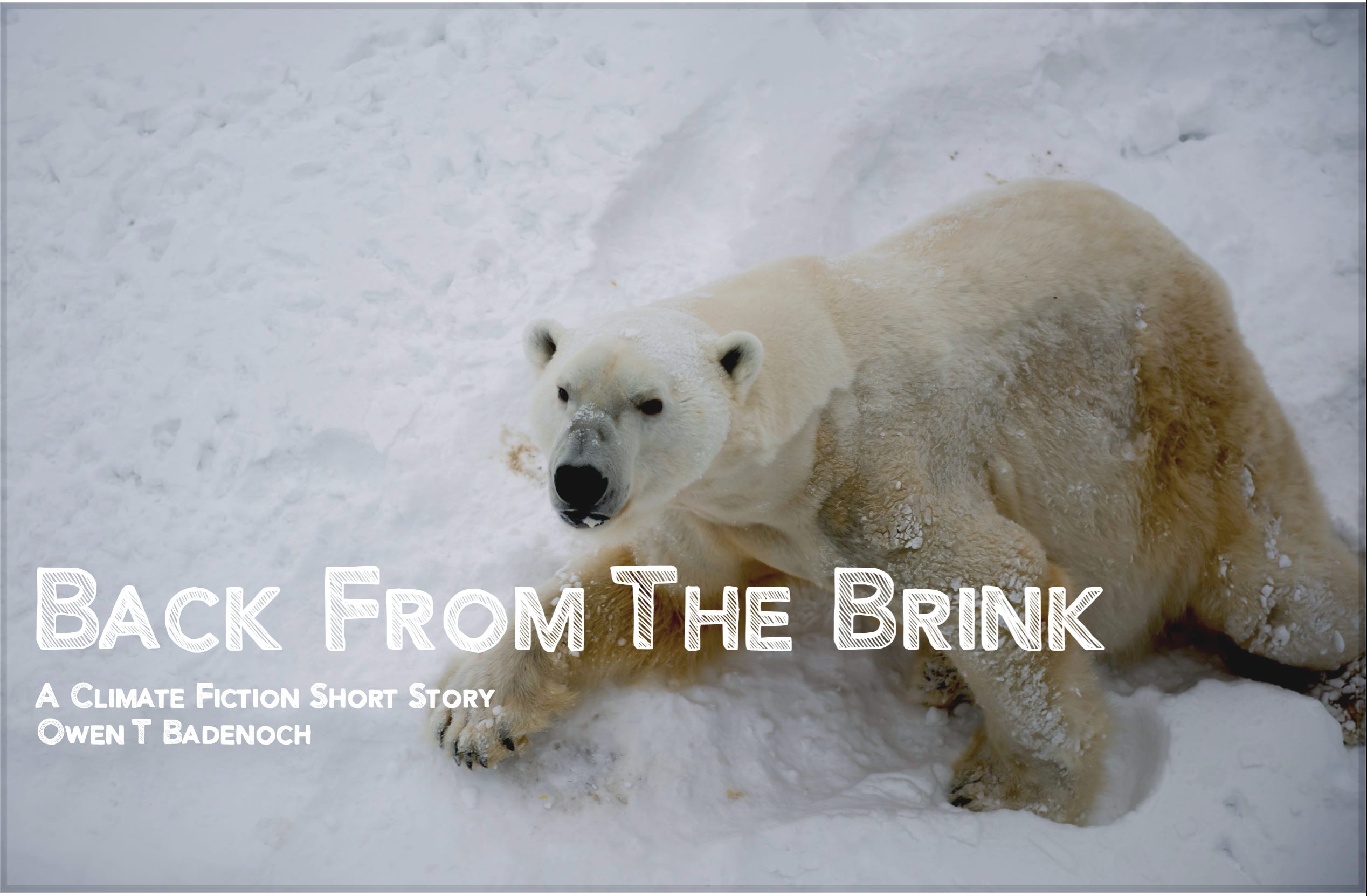
🇨🇦Happy Canada Day! 🇨🇦 Please enjoy this short story I wrote for potential submission. It’s still a bit rough around the edges and undergoing revisions. I’d love to hear what you think in the comments! -Owen.
Back From The Brink
By Owen Badenoch 2026-07-01
Why is it that when you think you’ve finally got it made, the Great Spirit or whatever goes and throws a polar bear at you? Or two. Or three. Would be just my luck, eh?
Here I was, on my day off, Yannick Brûlé, eighteen years old and freshly graduated from New Marlborough High, Class of ’52 (in New Churchill, population 30,000 and growing, of the great province of Manitoba, thank you very much. Go Storm!), lolling away on a fishing platform and thinking how good I finally had it: sunny spring day, plenty of fish, some free time, and dating Kona McKay. My grin was as wide as the horizon. I only had two things to stress about and I was doing my best to avoid both of them.
One, I had to decide soon if I was going to go out on the commercial fishing fleet in Hudson Bay with my dad. He was out there now fishing cod and would be back in six weeks and would need my decision. I had given him a tentative yes, but I hadn’t signed the contract yet. Or I could stay here in town and apply for the local college in Arctic Studies and be with Kona. Oh, decisions, decisions.
The second thing was that I had shirked off volunteer duty for town cleanup and was almost surely going to catch hell from Janice Culverson, the organizer when I got back. Tourist season was starting and everyone was asked to pitch in. Kona made me sign up. And I swear I was going to make up the shift another day. To be fair, if she would have been there today, so would I, but she was off on an interview for a summer internship with some superstar professor of fish or something from Montreal. I probably should’ve been listening better.
So I ‘borrowed’ a small fishing platform (really just a raft with a small cabin and a motor) and chugged out a couple clicks north toward the old submerged town. That was the original Churchill, before the great sea rise. Now it’s a popular diving spot for tourists in the summer. The platforms are actually for tourists, too, but hey, someone ought to test them out to make sure they’re safe, right? Why not me? Janice was head of the tourism board for town, and technically these motorized fishing platforms belong to the tourism centre. I’m definitely going to catch hell, but on a spring day like this? Perfect day for shirking.
Honestly, Kona should have come with me, instead. Lots of fish here. The water around my fishing platform glittered blue enough to hurt my eyes. even with my shades on. I didn’t have smart shades or anything, though. Not on my meager budget.
To the northwest, the rooftops of Old Churchill slept beneath fifteen meters of seawater. On calm days all summer long, tourist boats would drift over the drowned streets while divers swam through old churches and schools like they were exploring a poor man’s Atlantis at the now much-widened mouth of the Hudson River. Besides the old Anglican church, most of the buildings in the old town had been squat winter boxes built to withstand heavy winters. Not exactly wonders of the world. But I suppose there were the old fort and battery buildings, and a handful of cool shipwrecks. Not really my scene, but it sure drew plenty of divers each year along with bear watchers, bird watchers, research teams, anglers.
New Churchill sat on higher ground now, thriving and growing. Funny how things worked out. The sea had risen. The old town was gone. But the fish had come back. Not just a little, either. Schools of capelin and Arctic char moved beneath me in glistening ribbons a mile long. My tackle box chirped as it uploaded the latest mapping data to the community network. The fishers shared everything now. Fish locations, water temperatures, migration forecasts, etc. The data was now community owned, open and transparent and fair. This meant they could manage the fish populations and not make the same mistakes all over again.
Some of the old-timers said their fathers would’ve called it socialism. But the Indigenous elders called it a return to a better way of things, of balance and respect. I guess we’d needed a biblical flooding to check us back into behaving like a community. The conservation and repopulation efforts were finally paying off and, despite the higher sea levels, nature was adapting and bouncing back, and bringing the economy and tourists along with it. NewChurchill had become a shining beacon of the new Canadian Regenerative Economic Strategy. Only took them three generations and near total collapse.
The fish sure didn’t seem to mind. Nor did the tourists, who flocked like gulls up here every warm season. The actual birds didn’t mind either. The wide blue morning sky today was as alive as the water. Above me wheeled thousands of birds. Mostly thick-billed murres because of the colony nearby, but I also saw plenty of gulls, too. Everything shat on everything, of course, but that’s nature for you. I was proud to say, though, that I could now tell the difference between a herring gull and a ring-billed gull. Kona taught me. Pretty much everything I knew about nature around here and its majestic return came through Kona. She took me birding on one of first dates and we saw a northern hawk-owl. Before meeting her, I didn’t give two hoots (you’re welcome) about birds.
I leaned against the railing and thought about Kona, who I would only see on a little screen for weeks at a time after I took this job. Three months at sea split into two shifts. It was good money and tough, honest work. Dad had already offered to get me a berth. All I had to do was sign up. I kept telling Kona that I was just thinking about it. Leaving meant money, which I could use for college, or a house. But leaving also meant leaving Kona. I kept coming back to that one rather large snag in my reel-in-the-money plan.
Kona’s father wanted me to join the offshore fleet (of course), but I think he liked me well enough. Big Tom McKay, head of the polar bear task force in town. Technically, it’s now called the Urban Polar Bear Emergency Action Team. Yeah, that’s right. UPBEAT. That had to be a committee decision, right? Everyone here just calls it the Bear Force.
Dude was a local legend. Built like an oak tree, good sense of humor, and a hero around town for all the humane polar bear relocations he and his team did every season. Even had a huge mustache to complete the image of the burly Man of the North.
That season was coming up, too. The bears and the tourists eye-balling each other and Big Tom McKay between them like a UFC ref. Every time I was around the man, I felt the way I might feel if I was in a room with a good natured grizzly. Well, Mr McKay (I don’t think I’d ever be able to call him ‘Tom’) might probably not try to maul me. Probably.
Besides that, maybe I liked my life here in New Churchill more than I wanted to admit. My dad and I had moved here after a lot of drifting. It felt like a place I could stay, maybe. Even though I’d said yes to dad’s offer, I wasn’t feeling right about it. Was I really going to give this up just for good money? I suppose that’s just the way of it.
I’d been out on the water almost an hour and hadn’t even dropped a line. Maybe I’d just listen to some tunes and chill, clear my head. One headphone in with some classic old hip-hop tracks playing (my dad’s music, really, but good), I bobbed my head along with the undulating platform.
A pod of belugas surfaced less than half a kilometer away, their white backs gleaming in the sunlight. I lifted my smart binoculars (a graduation gift from dad) and got a closer look. Beautiful. Then I scanned the water. The display highlighted distant bird colonies, fishing buoys, marine traffic, and a few dozen dark shapes that represented ice floes. The spring ice was still just breaking up further north and carrying southward. The warm season started significantly earlier and lasted longer nowadays.
I turned back toward shore and the binoculars outlined something else: a polar bear sauntering along some rocky hills near the shoreline.
Range: 1.2 kilometers. Species: Polar Bear.
“Huh,” I said aloud. That wasn’t unusual. The bears had been making a comeback for years. Despite the lack of sea ice, the bears were starting to adapt to eating more eggs from ground-nesting birds, and more small land mammals, which were in abundance, along with the larger caribou herds. The bears were back.
The tourists loved them, and so did the biologists. The rescue teams dealt with them often enough.
And the bears themselves mostly tolerated the arrangement. I checked my phone and looked at the bear tracking app. It didn’t tag any known bears in the area, so this guy must have been new and not yet tagged. He looked like an almost mature juvenile male. Yeah, we get bear training every year in the school and do regular bear drills. Maybe I could report him to the Bear Force for tagging. But that would also be fessing up about the shirking and the illicitly borrowed fishing platform.
I shivered despite my jacket and scanned around to assess my surroundings a little more carefully. I spotted movement on the water.
Range: 0.8 kilometers. Species: Polar Bear
I zoomed in. Another bear stood atop a chunk of floating ice, yellow-white against the blue sea, and this one was looking right towards me.
“Uh oh.”
***
Back when I was a kid, we’d drifted around a lot. Halifax, Louisbourg, and St. John’s, where I watched an iceberg big as a mountain sleepily wind its way south. My first eight years, I’d been tethered to mum. Dad had gone out with on some fishing fleet every chance he got. Just as well since the only things he liked to do on land were drink and tell stories about being on the water.
When I was nine, though, mum got sick with late-stage pancreatic cancer and dad stayed. You could see it gnawing at him, being land-bound, but he stayed for us. And when her suffering finally ended, he stayed a while longer to make sure I was registered in an online school, and then we were on the move again. We even spent a year buried in the silencing snows of Sept-Illes, so it’s not like I didn’t know that deep northern winter cold.
Eventually we landed here. And New Churchill was something else. Even dad seemed to relax here and settle himself, at least as much as a restless sea-faring man like him ever could. He put me in a proper school, New Marlborough Secondary School, and went off to see about a union position in the Hudson Bay collective fleet. He came home at regular intervals to regale anyone within earshot and reach of a beer about the trials and heroics of the great men and women of the northern fleet.
At my graduation he had given me a pair of expensive smart binoculars and a job offer. It was a take-it-or-leave-it kind of offer, but I know he wanted me to take it.
He took me out to the Dancing Bear for a celebratory dinner and chatted away, like he always did, telling stories about the crew on his ship, the follies of the new guy (there was always a new guy), and of course how he saved the day when the engine died or a frayed hydraulic hose jammed them up for half a day, or when a man went overboard after catching a line wrong (usually the new guy). My dad could talk a mile a minute and still finish his fish and chips and a lager while I was only halfway through my whiskeybacon cheeseburger. When I was a kid, dad’s stories enthralled me and I loved to hear them again and again. But now, I don’t know, it all felt a bit put on, I guess. Today it sounded more like a sales pitch.
“There’s a berth for you as soon as you sign up,” he said. “One full season getting the shit kicked out of you as a junior trainee, then a union card and full salary.”
“What about university?” I asked.
He frowned like he’d been afraid I would ask about that. “Well, two full seasons will put you well on the way to covering tuition. To my mind, you’s gotta work first and read later. The fish aren’t in the books, eh.” His whole world was basically fish and water. I doubt he could’ve seen my dilemma no matter how hard he tried. But he also wasn’t going to push. We’d had enough rows over the years that he knew pushing would just get a push back. You couldn’t scare a fish into biting. The money was the lure and the fish would bite eventually, inevitably.
“What about Kona?” I asked.
He smiled and crossed his arms across his chest. He looked like he was about to make fun of me, but then changed his mind. Instead, he changed the subject to talking about some new technique they had to keep narwhals from getting caught up in the lines.
“Listen,” he said later, before turning in for the night. “You gotta decide what you want to do, but to my mind you’re too young to drop anchor just yet. Think about it. We’ll get you signed up when I get back.”
That’s what it was for him, I guess. The water was freedom, but land life was an anchor that held you in place, slowed you down and trapped you.
And then the next morning, with the sun hardly peeking over the misty bay waters, and it was a hug and a nod and he was off on the water again for six more weeks.
The hard part was going to be telling Kona.
***
The large polar bear my smart binoculars had flagged on the shore was still moving slowly southward in my general direction, even though I was still far enough offshore that it probably couldn’t do much about me yet.
I reeled in my line and began packing up my gear without rushing. No quick movements. No panicking. Bears noticed panic. At least I thought they did. Maybe that was sharks. Either way, there didn’t seem much point in advertising that I had suddenly become very interested in leaving.
The bear loped along the rocky shoreline almost lazily, like it had nowhere important to be. I kept my eye on the bear loping almost nonchalantly along the rocks. Every few meters it stopped to sniff around or poke at something between the stones. At one point it lowered its enormous head into a patch of little purple flowers growing stubbornly from between the rock. Purple saxifrage, called Aupilaktunnguat in Inuktut. Another bit of nature trivia gleaned from my brilliant girlfriend. She’d taken both Inuktut and Anishinaabe as electives. I had stuck with good old French, but even with the last name Brûlé, I was embarrassed to say I was hardly what you’d call bilingual.
The bear sniffed the flowers for another moment before continuing south.
“So long, buddy,” I muttered. I eased the motor into gear. The little raft vibrated beneath my boots and began crawling across the water.
That was the problem with these tourist platforms. They were designed for stability to keep nervous visitors comfortable while fishing or photographing belugas, not for speed. They floated like corks and moved like sleepy turtles. I might as well be an an ice floe. Still, if I could swing around the big rocky point ahead and stay offshore for another kilometer or so, maybe the bear would lose interest. Then I could cut back toward one of the public docks or beaches closer to town. Simple.
I occupied myself by taking inventory. Mostly because it kept my brain busy doing something besides imagining becoming lunch.
Fishing rod, smart tackle box, pole net, and emergency kit. Inside that were a water purifier, first-aid supplies, jerky, one safety helmet, and five emergency flares.
But no rifle. That particular oversight suddenly felt much larger than it had three hours ago. Not that I legally could have brought one anyway. I’d only turned eighteen a few months ago, so I didn’t have a license yet. To carry a rifle I’d have needed someone licensed with me, which in turn would have required admitting to somebody that I was shirking volunteer cleanup.
Hard to explain that one.
“Sorry, Janice, I couldn’t help pick up tourist garbage because I needed an adult to supervise me while I illegally borrowed your fishing platform.” Yeah, no, I don’t think that would’ve gone over well.
The motor droned quietly behind me as the raft crept toward the headland.
I glanced back and the bear on the sea ice was still there, still watching me. Great.
I rounded the rocky outcropping and as the shore opened up I saw the first bear again. No. It was a different bear. This one was another young male by the look of him, but he carried himself differently. Broader across the shoulders. The fur around his massive front paws was stained with dried mud, dark brown against the creamy white of its fur.
I stopped breathing for a second. Three bears? That didn’t make sense. Polar bears weren’t exactly known for teamwork. Polar bears weren’t social. Not really. I mean, sometimes you’d see mothers with cubs. Sometimes you’d see several feeding on the same carcass without immediately murdering one another. But this was different. Three young males spread out along the same stretch of coast? Something felt off here. I adjusted the zoom on the binoculars. The third bear remained where it was, watching me watching him. This one also wasn’t tagged. Most of the bears around New Churchill carried bright satellite tracking tags nowadays. Tourists liked following them. Researchers liked knowing where they wandered. Everyone liked avoiding unpleasant surprises.
If I lived through this, I’d have to ask Mr McKay about it.
The bear suddenly rose onto its haunches. Sweet mercy. Standing upright, or kind of half-sitting really, it looked at least a foot and a half taller than I was, I estimated. He lifted his nose into the wind.
Startled, I let the binoculars slip from my shaking hands. I snatched at them but my hand closed on empty air.
“No—!”
The thousand-dollar unit bounced once against the decking and vanished into the cold sea. The splash was absurdly small, like somebody swallowing. Gulp.
I stared stupidly into the water after them. For just a second I could still make out the binoculars tumbling toward the darker depths below before they vanished completely. I felt both like being sick and laughing at the same time as I realized I might be totally screwed, because losing the binoculars suddenly seemed like the least of my problems.
Then the hairs on the back of my neck stood up.
I heard another splash in the distance behind me. I spun around so fast I nearly lost my footing.
The bear that had been standing on the sea ice was gone and a broad white head cut through the dark water, swimming straight toward me.
Oh right. They can swim.
***
When I finally first went to have dinner with Kona and her family, this was back almost a year ago, at the start of the school year, we had been dating then for almost four months. I dressed sharp and showed up ten minutes early. “If you’re not five minutes early, you’re late,” is something my dad always said and so I figured ten was even better.
A great big grizzly bear of a man opened the door. The Métis legend himself, Big Tom McKay. Head ranger of the polar bear squad. Up til then I’d only seen man on stage at the polar bear awareness training days at school, or on the news when he and the Bear Force had tranqed on in town and put in the polar bear jail (it’s a a real thing) to await relocation.
“Ah, young mister Brûlé. Come in. How are we this evening?” He held out a hand as big as a bear paw.
“Yeah, good. Yourself?”
He shrugged his massive shoulders and looked back into the house. “Can’t complain, but do yourself a favor, bud. Tell Kona that you like her new haircut. It’ll save us both.” He winks and leads me inside.
Kona came down the stairs a moment later and smiled at me. It stunned me, just like it always did. I felt like a rookie actor on stage and I’d forgotten my line. Then I remembered.
“Hey, you look nice. I like your new haircut.”
She stopped at the bottom of the stairs and gave me a quizzical look. “My haircut? Is something wrong with my hair” She turned to a mirror that hung in the front hall, and started anxiously checking her hair.
“No, I mean you look good. It looks good,” I stammered.
“What looks good?” She asked with mounting panic.
I turned to find Mr McKay for help, but he was sitting on the Chesterfield biting one giant fist to keep from laughing.
“Daddy!” Kona cried when she saw him laughing. “Don’t be a jerk to my friends!” But the complaint had no teeth. “C’mon,” she said to me and then stomped toward the kitchen to help her mother. I saw a glimpse of the girl in the young woman, of the family that laughed both at and with each other. I wondered if this is where she got her sure-footedness in the world. I envied it.
“You said it would save us,” I said to Mr McKay in a low voice which I hoped sounded jovial, like I didn’t mind, and could be in on the joke.
“Well, it saved me from boredom, anyway!” He laughed loudly and clapped the armrest.
At dinner a little while later, I didn’t fare much better. Though the conversation was awkward, the meal was incredible. Mrs McKay served perfectly tender grilled caribou steaks with roasted new potatoes and carrots and a salad of local leafy greens and herbs.
“This is amazing, Mrs McKay!” I said and pointed to the steak, but she laughed and points to her husband.
“He’s the grill master,” she said. I turned to look at the massive man sitting at the head of the table like a king. He grinned, almost invisible under his mustache, and nodded.
“You’ll have to teach me your technique,” I said, hoping to win him over.
His face grew serious as he chewed another bite and swallowed. Then he shook his head. “Family secret, I’m afraid.”
From his tone, I couldn’t tell whether he was joking or not and we lapsed back into silence for a while. I looked to Kona for help, but she avoided my eyes.
“You look like you maybe have some First Peoples blood in you,” Mr MacKay said at one point, when we were done thoroughly establishing that I didn’t follow any of the Canadian sports team particularly well and had no interest in politics. “Any indigenous heritage?”
I quickly shook my head. “No sir. My mum’s mum was Chinese. I can trace my noble lineage as far back as her and as far away as Vancouver, sir. And everything else in me is maritimer French, I think.” I shrugged sheepishly but saw his further disappointment.
“And your father? He sounds like an East Coaster, but for all his constant talking, I don’t know much about him.“
You and me both, I thought but didn’t say. Instead, I turned this into a joke also. “Old Daddy Driftwood? I think I heard him say once that he had family down in Boston, or maybe it was Brazil.” I tried to laugh but the seated mountain of Big Tom McKay did not laugh with me.
“A man with no history is a ship with no anchor,” he said solemnly. “Who are your people then, eh?”
“Tom, stop,” his wife scolded him gently. “Maybe he is the start rather than the end. The dandelion seed can travel a long, long way before it sets down roots.”
Mr McKay accepted this wisdom and smiled at his wife, for whom I was suddenly very grateful. Kona said nothing, but watched me. Was this some kind of test? Of course it was. Wasn’t everything? She was her father’s daughter, after all.
“But ‘Brûlé’,” Mr McKay continued, less aggressive now, like he was just curious, as he cut his food, “that’s a very old name. From the French Voyageurs, like Étienne Brûlé, right?”
This is history that I was only vaguely familiar with, having learnt it way back in middle school online. But I honestly don’t know where our name comes from. If my own dad’s stories are anything to go on (which they usually aren’t), he probably picked the name off a monument or something after a particularly egregious bender when he needed to skip town and start fresh. I also didn’t know if this was a trap. Was Étienne Brûlé liked by the Métis or hated? I couldn’t remember, so I decided to feign ignorance, which wasn’t hard, and shrugged again. “I don’t know, sir.”
I was saved then by dessert. Mr McKay melted like a spring snowdrift when he saw his wife bring it to the table.
“My dear loving wife! Flapper Pie! You’ve outdone yourself this time,” he said without taking his eyes off the dome of crusted meringue and custard.
“Oh shush, you!” she giggled back. Kona rolled here eyes at their lovey teasing.
“Is this a special treat?” I asked innocently.
Mr McKay bellowed a laugh and I nearly dropped my fork. “I’ll say. Better start making wedding plans, son. She seems to think you’re part of the family already!”
“Daddy!” Kona wailed and stole a quick apologetic look in my direction. Her cheeks blushed pink like a sea dawn.
***
The raft’s motor complained as I pushed it as hard as it would go. I’d have to get past the third bear and to shore before the swimming bear behind could catch up. Polar bears are very fast swimmers.
“C’mon you stupid sunovabitch,” I muttered at the motor. I angled it as best I could to keep heading inland but southward. I was hoping to get as close to town as I could. I locked the motor in place and opened the emergency pack. First I pout on the helmet and grabbed the flares and shoved them into my jacket pockets.
You see the helmet was made of a super hard nano-steel shell over fireproof foam cushion. Why the fireproofing, you might ask? Because the helmet was designed with a special slot mount on the back top into which you can shove an active flare. That way you signal your location (hopefully) to the rescue Bear Force team that is (hopefully) on its way to you while still keeping two hands free for your rifle. Clever, eh? It was designed a few years back by an Inuk engineer. Million dollar idea, and now standard in all Arctic emergency bags. But did he get rich off his idea? Nope. He chose instead to open-source the patent and let everyone have it, making it affordable and accessible to the whole community. Typical northern logic. If something keeps your neighbors alive, you share it.
And right now I could’ve kissed him for it, because even though I didn’t have a rifle, I needed to pump both arms as I ran onto the shore and away from the bears. I cracked the flare and jammed the flaming thing into the helmet slot. As soon as the raft ran aground, I leapt out into freezing water up to my shins and starting running.
It was not a long chase. My heartbeat thundered in my ears. Some stupid thought flashed through my head: Kona was going to kill me. I almost laughed but I kept running as my lungs and throat burned in the cold air. She’d warned me plenty of times about fishing alone. I remembered promising to help repaint her family’s spare room tomorrow.
I remembered never answering Dad’s offer. I wanted to see the Rockies someday. I wanted to hold Kona again. Funny what your brain does when it ought to be figuring out how to survive.
Kona, sweet brilliant beautiful Kona. And in that moment I knew what I really wanted. I know which way my compass would point.
Then came the drones. I hear the whine and looked up to see two black silhouettes against the pale blue sky. In the distance I thought out I could hear the rev of ATVs.
Great, I thought as the bear kept coming. Now I’ll have an audience.
One of the bears hit me from behind and I collapsed. The impact felt like being struck by a truck. Its jaws closed around my thigh just above the knee. Pain exploded through me.
I screamed and my body folded. For one impossible second I found myself staring directly into the bear’s eyes. I smelled salt and fish and wet fur. The wild North itself, claiming its prey. One of the other bears growled nearby, closing in fast
The ATV sounds were close now, too, and i stretched to look toward the sound.
“Yann!” came a booming voice. Big Tom McKay. Kona’s father. The UPBEAT head ranger himself, hopping off the ATV and aiming his rifle towards me and the bear.
The bear’s jaws tightened on my leg and something cracked. White fire shot through my leg and my vision flickered with spots as I was lifted into the air and then slammed back into the ground.
Then came a sharp crack that wasn’t my bones but somewhere above and away from me.
Another sharp crack. They were shooting the bears. My stupidity was going to get these creatures killed.
Oh god, no, I thought absurdly. Don’t shoot them! Kona would never forgive me.
Then the world went black.
***
About a week ago, Kona and I had gone to a dance at the community center. It was a fundraiser for the bears. Well, not for the bears, obviously. But for the research centre. It was mostly early season tourists and lots of locals. Half the high school kids were there, even though so were there parents. Some members of the high school senior class AV club had a holo show going that moved with the music. One granny sitting on the side of the dance floor was shaking her head in wondrous disbelief.
The community in New Churchill is something that I hadn’t really got used to yet. All these people, just kind of knowing each other and their business. Pretty nice, I guess, if you’re into that sort of thing.
Before the night started, I had worried that Kona would read on my face the decision I’d made to take my dad’s job offer. But now, here, with her arms around my shoulders, I couldn’t think of anything but her with big, dark eyes and her gorgeous lips painted with a deep red lipstick to match her semi-formal knee length skirt over tights the same shade as the skin beneath. It was still spring in the Arctic, after all. She looked absolutely incredible.
She smiled up at me and mouthed along with the words of the old slow song that was playing as we swayed back and forth among a few dozen other pairs.
“Ooh baby, I heard it through the grapevine. How much longer will you be mine?”
And the worry was back. Did she know? Was she telling me she knew? Or was it just a song?
The song ended and she pulled me away from the dance floor and out to the deck of the community centre that faced out toward the tundra and, in the distance, Hudson’s Bay. It was a beautiful spring night and the air brisk. I’d left my coat inside over the back of a chair. She leaned on the railing and pulled me in for a kiss.
Then she asked what I’d been dreading.
“You talk to your dad yet?“
I shuffled my feet and looked over her shoulder out at the tundra, dark browns and grays in the twilight.
“Not yet,” I lied. The silence lingered too long, as she watched my face.
Just as I was about to say something, anything, to stave off the coming argument, she said, “I hope you decide soon. It’s better to know which way your compass is pointing before you start walking.”
She turned and pressed her back into me and I wrapped my arms around her.
The aurora borealis began to wave in soft currents above us.
After a moment Kona said, “You know in Finland they call them ‘revontulet’. It means ‘fox fires’. There’s a story that says the fire fox ran so quickly that sparks from its tail flew up into the night sky and stayed there. Isn’t that beautiful?”
I looked into her dark eyes, full of warmth and saw the fox fires reflected there, dancing.
“Yeah,“ I said, “really beautiful.”
She laughed playfully and kissed me again.
I wanted for this night to never end.
***
“You’ll be up and about in no time,” Doctor Spence said as he looked from my leg to his tablet and back again. My entire left leg was encased in a 3D printed lattice cast over a layer of bandages. Wires and tubes ran in and out of the bandages, all connected to a large machine that blinked and twinkled like a square Christmas tree. Maybe that was the pain meds working.
“But do try to keep weight off it for the first week or so,” he continued. “The bone was broken in several places and the nano-weave needs time to do its job properly. We’ll check for any nerve damage once the bone has been woven back into place. For now just rest.” He wandered off to consult more screens and more charts.
I lay there smiling dopily. I knew I’d made my decision, changed my mind. Through the fog of pain and very strong medication, I knew finally what I wanted.
I heard the door swing open and Tom McKay’s voice as he spoke to Doctor Spence.
“How’s the lunatic doing, doc?”
“Oh he’ll be fine. Left femur was crushed but the damage isn’t permanent. Some internal bleeding but we got to it quickly. May have a slight limp in the end, and a bloody good story to tell his kids. He’s pretty doped up on pain meds but he’s awake.”
McKay huffed something like approval.
Mr McKay came and leaned over me. “How ya feeling, bud?”
I put on a brave face, but my lips felt heavy, too thick. “Yeah, good.” I gave a faint thumbs up.
“You had quite a close call there with the great whites of the North, and you live to tell the tale. Your dad’ll be wanting to hear it, I’m sure.”
“You didn’t tell him did you?” I thought of my dad out on the fleet, unable to come in for another month at least, worried.
Mr McKay shook his giant head. “No, that’s up to you. But give him a call when you can. Best he doesn’t hear it from someone else first.”
I nodded sluggishly. “Hey, I’m really sorry about the bear.”
He raised one bushy eye brow. “The bear? He’s fine. Jeez, you didn’t think you’d beat him a wrestling match, did ya, bud?” He laughed and the hospital bed shook like an earthquake. Little currents of electric pain crackle up from my leg.
“You didn’t shoot it?” I asked, confused.
“No, no. Well, yes, we shot him. But only with the stingers. The other two scattered. He let go of you but we couldn’t tranq him from the drone without hitting you. Big fella. Still took four shots and almost five minutes before he went down for a nap. No, he’s over in the jail now, sleeping it off. We’ll move him out on Friday, probably. You want to come say goodbye to him?”
I was relieved that the bear wasn’t killed. I wouldn’t have to face Kona with the news that I’d got one of nature’s most majestic beasts killed just cause I was a dumbass. And me not dying was a nice bonus, too.
“No, thanks,” was all I managed. “Maybe best if he forgets me. I know I’ll never forget him.” I looked at my leg in its lattice wrappings and tubes. It looked like an alien machine thing eating me up to my hip.
Then I remembered something. “None of them were tagged,” I said. “And this is crazy, but it seemed like they were working together.”
McKay took this in and nodded sagely. “Well, we tagged the one that you tussled with. The team’ll go out and track the others with the drones and tag them. More bears the last two seasons. S’good news for the bears, but more work for us, I suppose.”
“And the pack hunting?” I asked. Maybe I imagined it? The drugs were making me woozy and I questioned my own memory.
He rubbed his chin and said thoughtfully, “Less sea ice and shorter cold seasons means more land hunting and foraging. Adaptation maybe? Almost all animals teach their young. Why not the bears? I’ll let the research center know about it and see what they think.”
Then a grin split his face and lifted his massive mustache. “Hey, buddy. So no fishing fleet for you for a few months, I hear.” His grin widened more than I’d ever seen him smile before and he patted my leg. I winced at the pain and nearly lifted off the table. He chuckled. “Sorry, bud. I guess you won’t be going anywheres for a while, eh? Maybe you’ll be lookin’ for a job in town. The Bear Force might just be hiring, eh.” He winked.
I’ll bet he meant it to be mean, like he’d got one on me. Like he’d caught one for his daughter. A prize he could keep under his watch. But there was a twinkle in his eye as he looked at me, and he was still smiling broadly. Maybe it was a compliment, and he did like me after all.
“Yes, sir,” I wheezed. “I look forward to seeing how you cook those caribou steaks.”
He laughed and out of the corner of my eye I thought I saw Doctor Spence flinch. McKay nodded then, and more gently put a hand on my shoulder for a moment before walking away.
I lay back and smiled despite the ripples of dull pain. A warmth spread through me as I lay there, and I relaxed. Or I may have pissed myself. Like I said, the drugs were pretty good. I wondered how the bear felt.
When sleep finally pulled me under, I dreamt of Kona, lovely Kona, and all the beautiful colours of the fox fires dancing in her eyes.
***
About The Story
This story came about from the seed of an idea for climate fiction and the fact that I love polar bears. Imagined a character on a fishing raft, coming of age after the seas had risen and wondered if, despite that fact, environmental protection strategies might give the polar bears just enough time to adapt and return from the brink of extinction. Once I had an opening and a sense of the character, the story gradually began to take shape. I usually find that themes appear late in the process, after I’ve digested the story more fully (on revision). The title came about somewhere between the second and third draft as I realized young Yannick was on the brink of death, the shoreline, a major decision about his future, the brink of adulthood, and the bears were on the brink of return as opposed to extinction. I also wanted to keep pushing myself to use more first person character “voice” in my stories, my long-standing default being an omniscient or limited third person. I was pushed to actually finish the story by the desire to submit it to an anthology competition this summer. It will probably undergo a couple more revisions before that submission.
While this story is optimistic about the future of the Polar Bears, in the here and now, the situation is looking grim. Please, if you can, donate to Polar Bears International.org to help them in their efforts to protect these amazing animals.
Anyway, I hope you enjoyed it. Please do let me know what you think in the comments and please re-stack or share it with someone you think might enjoy it.
Gravity of Darkness returns next Wednesday with an action-packed chapter!
-Owen.
I enjoyed the first person voice. It gave an immediacy to the story that helped create the tension and hold my interest. An optimistic perspective on the future as we live through climate changes. I liked the story! Thanks.
I really enjoyed this one, thank you for sharing your creativity on here!